NEWS
&
Events

Operation Crayweed in the news and reaches first target!
The Operation Crayweed Crew has been so excited at the media interest in the project since launch.
The Operation Crayweed Crew has been so excited at the media interest in the project since launch.
We have so far enjoyed coverage from Nine News and ABC News, weekend coverage from The Sydney Morning Herald and The Huffington Post. Ziggy and Alex have been interviewed for radio this morning (Monday). What an incredible way to start our campaign.
Check out some of the coverage on the Operation Crayweed facebook page. Excuse the audio quality on the files!
Thanks in part to the solid media attention over the last few days, we are extremely proud to announce that we have achieved our first phase target of $20,000. This will enable us to kickstart our project with the restoration of 4 key sites. The campaign is just beginning and we are humbled by the huge response from the local community - check out the kind words from our supporters on the crowd-funding site.
The next step is to try to restore more sites - for every $20,000 raised we are able to restore crayweed to another 4 sites along the stretch of 'deforested' Sydney coastline. Don't stop! There's still no better way of demonstrating your love for Sydney's oceans than by buying someone an Underwater Christmas Tree for Christmas this year!
The Huffington Post: " ‘Operation Crayweed' Aims To Bring Back Sydney's Underwater Forests With Crowdfunding", by James Bullen
A possible solution to reducing Australia's carbon emissions may lie at the bottom of the ocean, and the Federal Government is eyeing off 'Blue Carbon' as a weapon against climate change.
Read the full article at - http://www.huffingtonpost.com.au/2015/12/05/operation-crayweed-unsw_n_8714216.html
A possible solution to reducing Australia's carbon emissions may lie at the bottom of the ocean, and the Federal Government is eyeing off 'Blue Carbon' as a weapon against climate change.
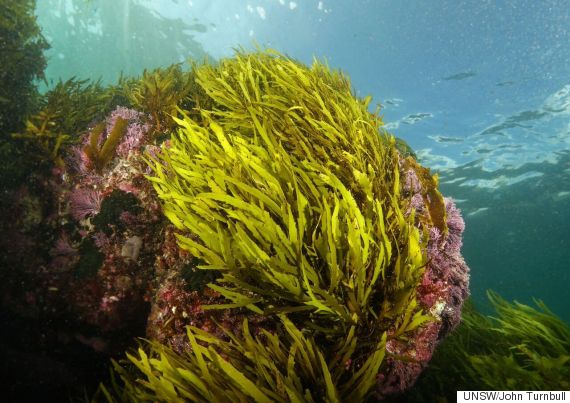
Off Sydney’s coast, there is a massive “seaweed forest” hidden beneath the water and it is home to vibrant, complex ecosystems.
Over the years, much of that forest has been lost, but getting back could help battle the impacts of climate change by reducing Australia’s greenhouse gas emissions. That's according to a lead researcher on a new project to restore seaweed to the area, Dr Ezequiel ‘Ziggy’ Marzinelli.
"In the same way as trees do, marine vegetation can sequester carbon. Having a large number of seaweeds doing so can have a meaningful impact on the environment," UNSW and Sydney Institute of Marine Science researcher Dr Marzinelli told The Huffington Post Australia.
The Federal Government committed on Thursday to a research project exploring the possibilities of sequestering carbon in such a way, calling it “blue carbon”.
“Blue Carbon –- carbon stored in marine and coastal habitats –- could play a significant role in reducing emissions, while also supporting biodiversity conservation, fisheries habitat protection, and disaster risk reduction,” a statement from Environment Minister Greg Hunt read.
But first, Dr Marzinelli says, the crayweed forest has to be restored.
“In the early 1980s, this massive crayweed forest disappeared from 70 kilometres of coastline around metropolitan Sydney,”
“It’s gone -- from Palm Beach, up in the north, all the way down until you hit Cronulla.”
Crayweed is a particular species of seaweed, which scientists say is vitally important as a habitat for marine life.
It provides food and shelter for fish and other organisms, and is also a considerable commercial asset. Abalone and crayfish live in and around the seaweed, providing a rich hunting ground for fishers.
Though the cause of the loss of flora is ultimately unclear, researchers say there is a strong correlation between the disappearance of the seaweed and poor water quality, which is the result of Sydney's massive growth and poorly treated sewage entering the waterways in the '80s.
Since then, Sydney’s water quality has vastly improved. But the crayweed hasn’t returned, and so UNSW scientists began to explore the possibility of intervening to reintroduce the seaweed to the 70km of coast it had been lost from.
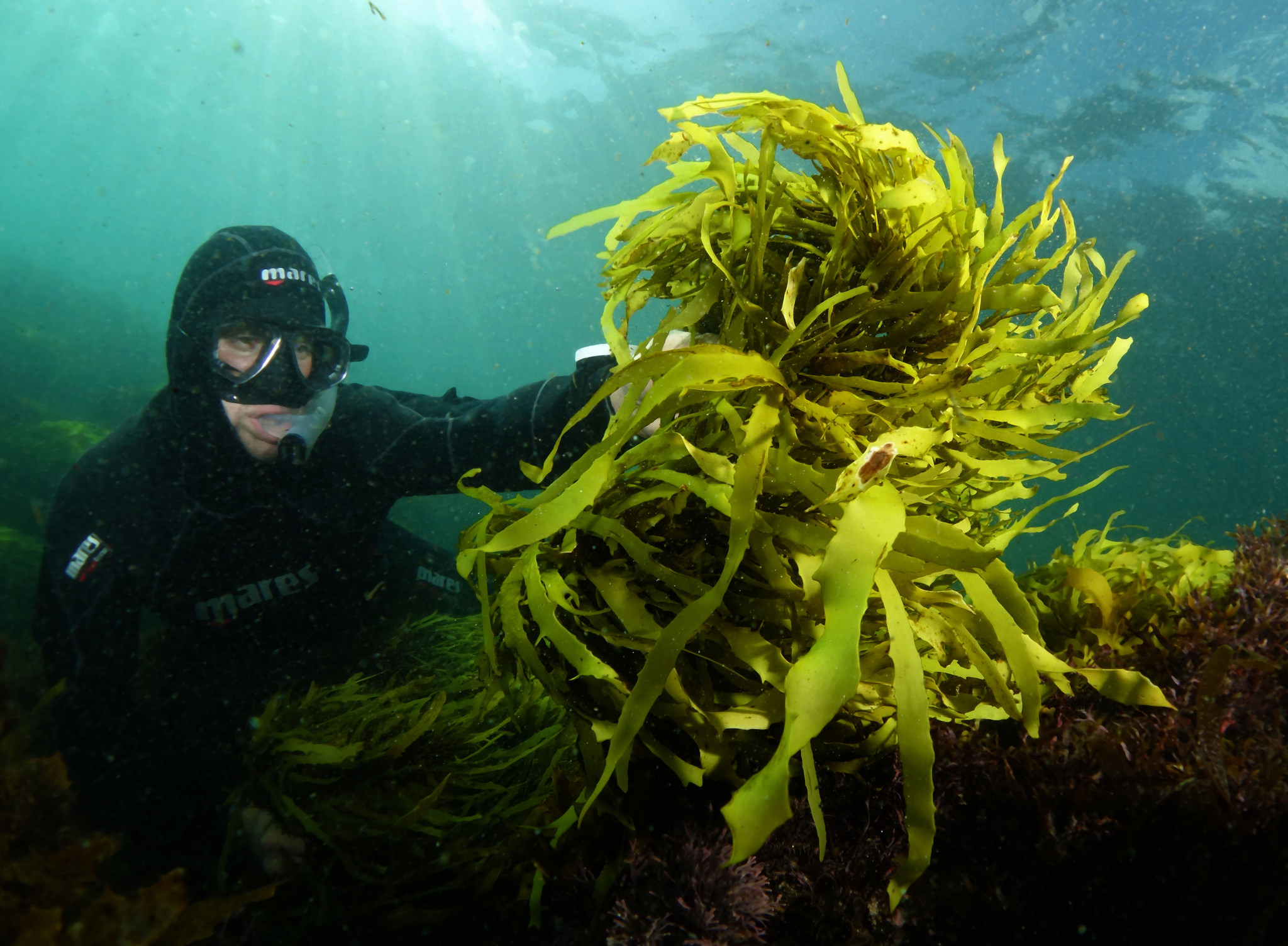
They took fertile adult crayweed from existing forests and transplanted them to new areas, fixing them to existing reefs with biodegradable mesh.
“Not only do they do well when you bring them back, but they start having lots of sex, start reproducing, and you start seeing babies,” Dr Mazinelli told HuffPost Australia.
“They start to expand this forest further away from the transplantation site; they’re self-reproducing.”
Now, the team is trying to rebuild forests across the entire coast, and is asking for help from the public.
They've launched 'Operation Crayweed.' There’s a slick social media and crowdfunding campaign -- complete with a crayfish casually chucking a shakas.
“Essentially, we are asking people to sponsor individual ‘trees’ that we will transplant onto the reefs on their behalf. It’s a perfect Christmas gift to the environment,” campaign scientist Dr Alexandra Campbell said.
Seven thousand individual ‘trees’ are needed to repopulate the 70km zone stretching from Palm Beach to Cronulla, and people can donate $20 to plant their own underwater tree.
“Seaweeds sequester a lot of carbon. We don’t know how much this species sequesters (but) we’re doing research on that at the moment,” Dr Marzinelli told HuffPost Australia.
“But definitely in other parts of the world, for example on the north-west coast of the US, they have shown different seaweeds can sequester carbon very effectively.”

Sydney Morning Herald: "Crowdfunding campaign to restore Sydney's lost crayweed forests" by Kim Arlington
Beneath the waves of Little Bay, Cape Banks and Long Bay, researchers have been restoring lost forests of crayweed, mixing male and female plants to let nature take its course.
Read the full article at - http://www.smh.com.au/nsw/crowdfunding-campaign-to-restore-sydneys-lost-crayweed-forests-20151204-glff20.html
There's a lot of sex going on just off Sydney's coastline, and scientists want to see even more of it.
Beneath the waves of Little Bay, Cape Banks and Long Bay, researchers have been restoring lost forests of crayweed, mixing male and female plants to let nature take its course.
The crayweed has reproduced so successfully that scientists are seeking public help to plant it from Palm Beach to Cronulla.
A team from the University of NSW's Centre for Marine Bio-Innovation and the Sydney Institute of Marine Science has launched a crowdfunding campaign to establish 7000 crayweed plants along the 70-km stretch of coast.
They are encouraging people to "plant an underwater tree this Christmas" by donating to the Operation Crayweed campaign.
Crayweed provides food and shelter for hundreds of marine species, including fish, crayfish and abalone. It disappeared 30 years ago from the city's coastline, where poorly treated sewage had been pumped for years.
"Despite a massive improvement in water quality in the early 90s ... this seaweed did not come back on its own," said lead UNSW researcher Ezequiel "Ziggy" Marzinell.
"We [wanted] to answer a simple question: 'Now that the water quality is good, can we start replanting this forest back onto the Sydney coastline?'"
After eight years of research, the scientists developed a way to transplant fertile adult crayweed plants onto bare reefs, where they are reproducing to create new, self-sustaining populations.
Each crayweed is tied to biodegradable mesh fastened to the reefs at a depth of two or three metres.
"We found not only do they do really well when you bring them back, but also they have lots of sex, so they start reproducing a lot," Dr Marzinelli.
"After three to six months you get lots of babies around and within the transplanted batches. Those babies after a year or two become adults themselves .. .and start having sex as well, and those patches start expanding. You go from a desert to a forest."
Dr Marzinelli said Sydneysiders loved to go diving, snorkelling and fishing. "All these things are underpinned by this underwater forest," he said.
A project of this scale has not been attempted in Australia before.
But researchers believe the marine habitat can be restored, with obvious benefits for biodiversity and recreational fishing, and that the same method could be used for other marine restoration projects in Australia and internationally.
They say public contributions through Operation Crayweed will help bring the reefs back to life.
"It's Christmas time," Dr Marzinelli said. "The best present you can give ... is to do something for the environment and plant underwater trees."

ABC News: "Scientists work to restore seaweed forests off Sydney's coast" by Nicole Chettle
Scientists are rejuvenating barren, rocky reefs off Sydney by restoring underwater seaweed forests that disappeared due to pollution in the 1980s.
Read the full article at - http://www.abc.net.au/news/2015-12-03/scientists-restoring-underwater-seaweed-forests-off-sydney/6999948?pfm=sm§ion=environment
Scientists are rejuvenating barren, rocky reefs off Sydney by restoring underwater seaweed forests that disappeared due to pollution in the 1980s.
Researchers from the University of New South Wales (UNSW) and the Sydney Institute of Marine Science (SIMS) plan to transplant 7,000 crayweed specimens along a 70-kilometre stretch of coast from Palm Beach, in the city's north, to Cronulla in the south.
Alexandra Campbell from SIMS said while marine waters appear healthy, at closer inspection some patches look like an underwater desert.
"It's actually quite shocking going diving and snorkelling around Sydney and further south," Dr Campbell said.
"There are huge, vast expanses of completely bare rock."
Dr Campbell said crayweed was wiped out in some areas – and never grew back.
"Up until the 1980s Sydney's sewage went more or less directly into the beaches and bays and this is essentially a hangover from that pollution."
Researchers have successfully transplanted crayweed onto rocky reefs at Long Bay and Cape Banks.
Now they are seeking $35,000 in crowd funding to repopulate Sydney's waters as part of a project dubbed "Operation Crayweed".
The idea is to encourage Australians to buy an "underwater Christmas tree" this festive season.
Adriana Vergés, the senior lecturer in Marine Ecology at the UNSW said the team is attaching what they call trees back onto bare rock.
"And they're surviving, they're staying there and they're reproducing," Dr Vergés said.
The lead researcher, Ezequiel Marzinelli, said "lots of sex" happens – and there are "babies" on the reef within a few months of the transplant, providing important habitat for sea creatures.
And he said that was good news for commercial and recreational fishers.
"You are potentially bringing back lobsters, abalone and so on," Dr Marzinelli said.
"Bringing these 'trees' back – you're also bringing back all of these creatures that people like eating."
Researchers said their method of attaching crayweed to an underwater "net" on rocky reefs was highly effective – and could be applied to marine restoration sites elsewhere in Australia and around the world.
Operation Crayweed Launch Event
The amazing Corner House in Bondi have offered to host our Launch Event!
Operation Crayweed Launching Dec 3rd
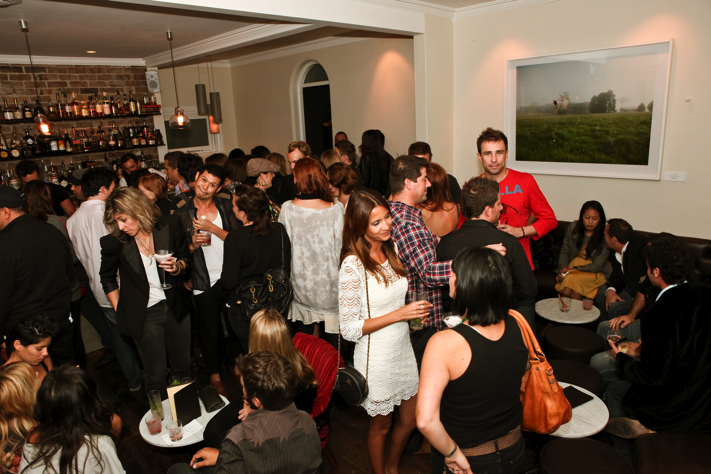
Come and join us at The Corner House in Bondi to celebrate the launch of the long-awaited Operation Crayweed project. This rare, good-news environmental story that we are very proud of needs celebrating!
We would like to invite you to the launch of our crowd-funding campaign, on:
Thurs 3 Dec
The Corner House, 281 Bondi Rd, Bondi (corner of Bondi Rd. and Denham St)
Our campaign is focused on ‘planting an underwater tree this xmas’, and as part of the launch we have secured a pretty special array of prizes to give away thanks to our generous sponsors including Dive Centre Bondi, Lost Paradise, Chapelli Cycles and Katzi.
Thanks also to the generous folk at the Corner House for hosting this event.
Enjoy your first drink on us.
From 630pm till 830pm
Goodie raffles and underwater gardening advice will be available.
For more details see our facebook event page.
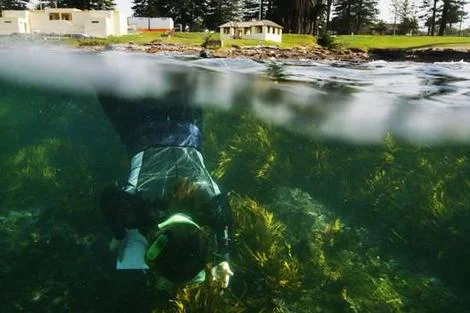
Sydney Morning Herald: "Missing: a 30-kilometre undersea forest", by Richard Macy
IMAGINE the outcry if more than 30 kilometres of forest in the foothills of the Blue Mountains suddenly vanished.
Read the full article at - http://www.smh.com.au/news/environment/missing-a-30kilometre-undersea-forest/2007/08/03/1185648145706.html
IMAGINE the outcry if more than 30 kilometres of forest in the foothills of the Blue Mountains suddenly vanished.
That has happened to a "forest" of seaweed that once stretched along the NSW coast.
In the 1940s cray weed, or Phyllospora comosa, grew in the rocks just below the high tide mark, providing food and shelter for scores of marine species.
But now it has disappeared from Sydney's waters, say two marine ecologists, Brendan Kelaher from the University of Technology, Sydney, and Melinda Coleman, from the University of NSW.
In a recent survey they found lush stands surviving on the South Coast, south of Kurnell, and more to the north, from Palm Beach to Port Stephens. But from Newport to Cronulla "there is just this big hole," said Dr Kelaher. They "couldn't see a single plant, which is really disturbing".
Up to three metres tall, it once formed "a forest under water" along Sydney's coast. Its place has now been taken by another algae, resembling turf. "It's like chopping down all the trees in a forest and replacing them with grass," said Dr Kelaher.
The scientists suspect the culprit was sewage, which flowed for decades from outlets off Sydney's beaches. Cray weed's reproduction is sensitive to sewage.
What worries the scientists is that the seaweed was a habitat for crabs, worms and shrimplike creatures, "all of which are fish food", said Dr Kelaher.
What impact the seaweed's loss has had on fish and marine animal breeding stocks is unknown. "But it's clearly going to be significant," said Dr Kelaher. "All the people old enough to remember when it was around say there used to be more fish."
The scientists believe the seaweed has failed to recover - despite the building of pipes that now pump sewage far out to sea - because it cannot compete with the turf-like algae.
They are proposing to recruit volunteer divers to transplant the cray weed, restocking Sydney's beaches.
Since cray weed does not have conventional roots, Dr Coleman conceded it would be a serious challenge. One plan involves clearing the invading algae and attaching cray weed spores to rope nets that would be draped over underwater rocks. The scientists hope the infant seaweed would eventually grip the rocks.
"It's going to be quite labour intensive," warned Dr Coleman.
Dr Kelaher said the seaweed's demise was so gradual it almost went unnoticed. While a 1970s research paper suggested it was in decline, "people got so used to not seeing it there that no one realised it was gone".